Chemistry Graduate Programs
Graduate Programs
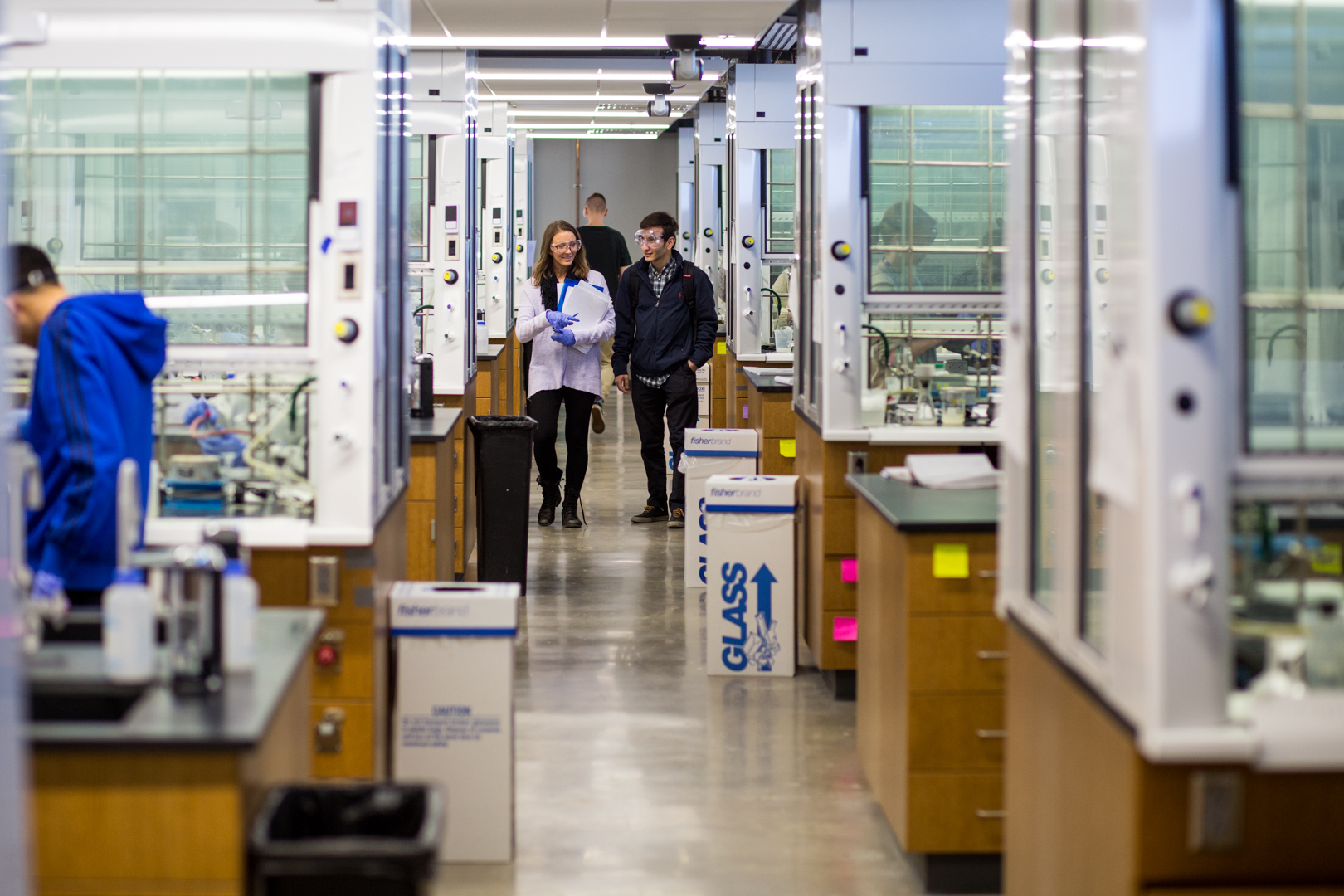
We provide state-of-the-art facilities for advanced study and research. Dive deep into research or prepare for exciting global career opportunities in the chemical, biomedical, nuclear, pharmaceutical and energy fields.
TALK TO A GRADUATE ADVISOR IN THE SCHOOL OF SCIENCE AND ENGINEERING
Master of Science in Chemistry
Students who earn their M.S. in Chemistry receive the skills and knowledge necessary to conduct specialized research and are prepared for competitive careers in industry, business or academia.
This program is designed both for students who wish to remain in their current positions while taking classes as well as those pursuing a full-time, research-intensive path. The department has a small research mentor to graduate student ratio that facilitates close interaction between students and faculty. We currently offer both a thesis and non-thesis option for obtaining an M.S. in Chemistry.
Thesis option
Full-time students are expected to choose the thesis option, which has an emphasis on coursework and research. It requires a minimum of 31 hours of coursework in chemistry and the presentation of a thesis. With this option, students must choose a research advisor and a thesis subject. A candidate's thesis must meet all the requirements set forth by the UMKC School of Graduate Studies.
Non-thesis option
Students pursuing the non-thesis option for the Master of Science in Chemistry are expected to have an emphasis on coursework. This option requires a minimum of 31 hours of coursework.
Natural Sciences Ph.D. in Chemistry
UMKC offers a Natural Sciences Ph.D. program which takes a multidisciplinary approach to earning a doctorate.
Learn more about the Chemistry Discipline
apply to the natural sciences ph.d. in chemistry
Research Areas
- Asymmetry and chirality
- Bonding theory
- CO2 conversion into fuels
- Electrocatalysis and electrochemical kinetic
- Electrochemical synthesis
- Electrochemistry of mesoporous structure
- H2 production through photocatalysis and electrocatalysis
- Infrared and raman spectroscopy
- Inorganic biochemistry
- Interface of art and science
- Microwave shielding materials tests and evaluation
- Molecular electrochemistry
- N2 conversion into ammonia/hydrazine
- Nanomaterials synthesis and characterizations
- Organic chemistry
- Organic pollutant and metal ion removal